

Exploratory project PlantRBA (2021 - 2023)

Predicting plant phenotypes under combined stresses using resource allocation models

Climate change, the scarcity of certain natural resources and the need to reduce agricultural inputs have increased the number and diversity of situations that agronomists need to understand. They need plant models with extensive predictive capability and capable of taking into account complex environmental conditions, where different constraints (stresses) come into play at the same time.

Context, key challenges and goals

Being able to predict a plant’s response to its environment is currently one of the major challenges for plant biology. Indeed, the multiplicity of transformations associated with climate change, the increasing scarcity of certain natural resources and the need to reduce crop inputs have resulted in a greater variety and complexity of situations to be managed by agronomists.

To help this work, individual plant models are already available – physiological models, for example. However, the capacity of such models to integrate complex situations is limited, as they cannot properly describe the processes at work at the cellular and molecular scales – the scales at which adaptation occurs.  For this, new multiscale models need to be developed. The PlantRBA project therefore set out to address this need by refining the description of the cellular and sub-cellular scales in plant modelling (and, more generally, in the modelling of multi-cellular organisms), seeking to establish an improved account of the connection between an organism’s genotypes and its phenotypes.

The approach adopted by the project was to develop, calibrate and experimentally validate the first mathematical model able to predict the phenotype for the model plant Arabidopsis thaliana under combined stress conditions (limited nitrogen and/or water availability). The resultant multi-scale model is based on the Resource Balance Analysis (RBA) framework and has been designed to resolve the problems associated with linear optimization methods. It also integrates a large quantity of data on molecules and the biological processes at work in A. thaliana under combined stress conditions. To create the model, an interdisciplinary team – bringing together experts in applied mathematics, computer science and plant biology – first focused their attention on the photosynthetic cells in Arabidopsis thaliana leaves. The modelling integrated both cellular and molecular scales, and an experimental element was included in the project to enable the model to be calibrated and validated.

Outcomes

Modelling outcomes: a refined model with associated tools

An initial version of the RBA model was developed in the first year of the project, along with ensemble algorithms and the PlantCellRBA program. This initial mathematical model was able to predict the phenotype response of the plant cell under investigation in relation to relative growth rate and the C:N ratio, in line with the reference data. The PlantRBA project also demonstrated the model’s capacity to make accurate predictions under complex conditions and without the need for empirical constraints, unlike other standard constraint-based modelling methods such as Flux Balance Analysis.

A first master’s dissertation enabled the initial model to be standardized, annotated and completed. The model was then subjected to a group expertise by the IJPB and MaIAGE teams at mid-project stage through a project workshop retreat, before being published [1-2]. The PlantCellRBA program has been the object of an invention disclosure (number DI-RV-23-0101).

A second master’s dissertation subsequently allowed a dedicated R package to be developed so that ‘interest reactions’ within a metabolic model (combining differently-expressed genes, proteins and metabolites) could be revealed interactively using the MetExploreViz tool developed by INRAE’s Toxalim JRU. This R package will facilitate the exploration and interpretation of omics data.

Experimental outcomes: a vast phenotypical dataset

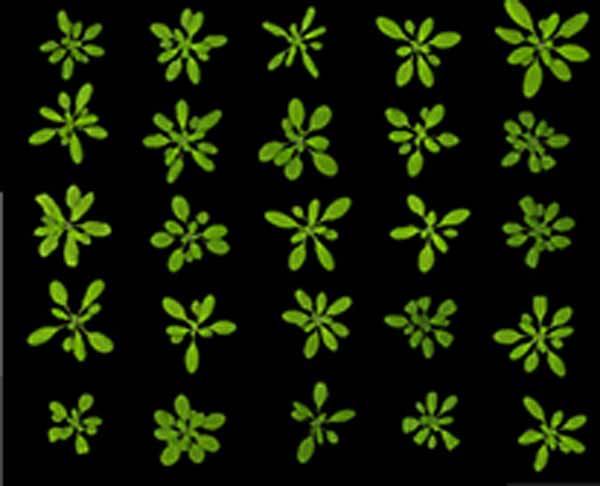
The experimental part of the project allowed a substantial database to be generated using the IJPB’s Phenoscope, a high-throughput phenotyping tool that allows the cultivation and simultaneous observation of hundreds of plants. The team was thus able to collect proteomic, transcriptomic, metabolomic and phenotyping data for nine sets of environmental conditions (varying the supply of either water or nitrogen, or both) and for two genotypes. These data were used to validate the model, first under controlled conditions without stresses, or with a single stress (linked to a single resource), and then to define its validity domain under combined stress conditions.

Perspectives for the future

Two new partners to continue the research as part of the ANR ModLSys project

This project has allowed the existing collaboration between MaIAGE and the IJPB to be consolidated, while opening the door to new partnerships. Indeed, this research will now be continued through the provision of funding by the ANR for the ModLSys joint research project (2023-2028), which brings in two new partners:

  • The MICS unit (Mathematics and Computer Science for the analysis and modelling of complex systems and data) at CentraleSupélec, which will process the experimental data and link it with the RBA model;
  • INRAE’s Institute of Plant Science in Montpeller (IPSiM), which will contribute to the integration of root responses at whole-plant scale.

Part of the funding, a total of €516 k over 5 years, will be allocated to the support of two years of post-doctoral research and two and a half years of engineering work. The primary goal of the ModLSys is to deepen understanding of nitrogen management during the exponential growing phase, combining biological approaches with mathematical modelling to analyze the different adaptive responses of the plant. This project makes extensive use of PLantRBA’s outputs, not least the experimental setup to be used to calibrate and/or validate the new models, the dataset produced by the project [3-4], the model itself, and the PlantCellRBA program [2].

These projects will be complemented by Nadia Bessoltane’s thesis (begun in 2024 and accredited by DIGIT-BIO), which has been designed to evaluate how metabolic models can be used to explore and analyze omics data. 

Contacts :

Partnerships

INRAE participants

Mathematics and digital technologies division 
Expertise
UMR MAIAGEmodelling, systems biology, omics data analysis and integration, bioinformatics.

Partners

 
Expertise
UMR IJPBphenotyping, physiology, bioinformatics, genetics
 

Publications

Journal articles

  1. Anne Goelzer, Loïc Rajjou, Fabien Chardon, Olivier Loudet, Vincent Fromion. Resource allocation modeling for autonomous prediction of plant cell phenotypes, Metabolic Engineering, 2024, 83, p 86-101 ⟨10.1016/j.ymben.2024.03.009⟩. INRAE major scientific breakthrough, 2024.
  2. Oliver Bodeit, Nadia Bessoltane, Delphine Charif, Anaghim Temtem, Olivier Inizan, Anne Goelzer.  RBApy: Extending resource allocation modeling to eukaryotes in complex environments. Preprint 2026. https://hal.inrae.fr/hal-05585881.
  3. Bacave, H., Huguet, P., Belin, E., Gilbault, E., Zurfluh, O., Loudet, O., Letort-Le Chevalier, V., Goelzer, A. From Phenoscope to GreenLab model of Arabidopsis to decipher genotype and treatment effects. In 2025 Joint International Conference on Crop/Plant Modeling, Big Data and Applications (2025PMBDA).
  4. Bacave, H., Huguet, P., Belin, E., Gilbault, E., Zurfluh, O., Loudet, O., Letort-Le Chevalier, V., Goelzer, A. From Phenoscope to GreenLab model of Arabidopsis to decipher genotype and treatment effects. Preprint 2026. https://hal.inrae.fr/DIGIT-BIO/hal-05611239.