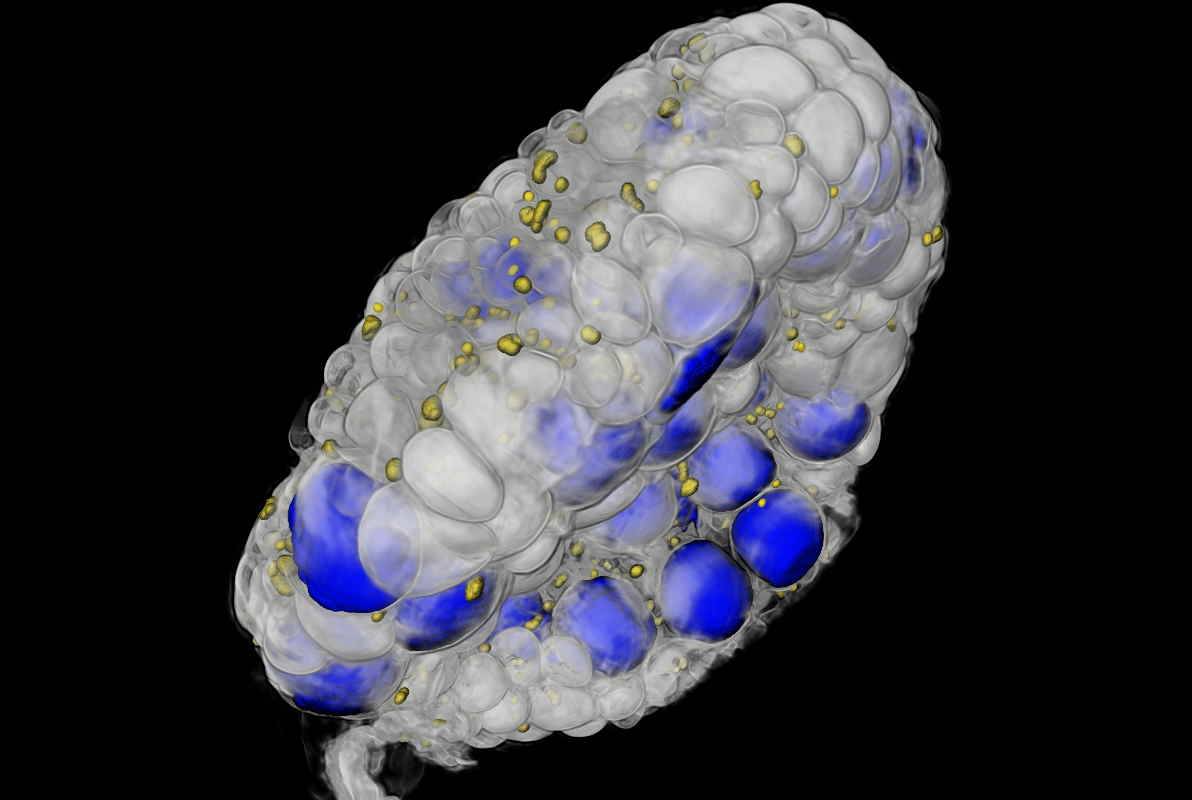
Visual representations of fish oocytes using AI and 3D imaging
In both natural habitats and fisheries, the formation and development of female gametes (oogenesis) is key to reproductive success in fish and is still little understood. The IMMO project seeks to study and model these mechanisms.
Context, key challenges and goals
In multiple-spawning fish, oogenesis involves the permanent turnover of the anatomical structures, ovarian follicles, that support the development and growth of gametes until spawning occurs. Although many regulatory actors have already been identified, there are still gaps in our knowledge of the dynamics of this process. Important questions remain unanswered: whether there is detectable aging of the ovarian function; what the key regulators for the ovarian follicles at different stages of maturation might be; and the extent to which the follicle population self-regulates.
The goal of the IMMO project was to make use of new 3D-imaging and artificial intelligence (AI) techniques to generate visual images and to enumerate all oocytes in fish ovaries at different ages, in order to provide a comprehensive and quantitative description of the entire oocyte and ovarian-follicle populations. These data would then be used to validate a mathematical model describing follicle dynamics and their regulation over a fish’s life span, making available information that could not be obtained from the data alone. The IMMO project used the female ovaries of the medaka, or zebra fish (Oryzias latipes), a model species from southeast Asia commonly found in exotic fishkeeping.
Outcomes
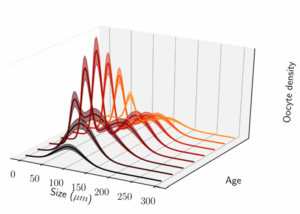
Ovarian density as a function of height and age
Distribution and size of oocytes in fish ovaries
The project enabled the precise quantification and measurement of the oocytes present in the ovaries at different life stages, from the larval stage to adulthood. The results show that follicle distribution evolves from a synchronic state in juveniles, where all follicles are in an early stage of vitellogenesis, to an asynchronic state in adults, where follicles at all stages of oogenesis are present. In females nearing end of life, the follicles are more synchronized at early stages of oogenesis. These data have made it possible for the stages of follicular growth in medaka to be re-defined, and an association to be established between follicular size and biological functions (hormonal secretion, growth).
Multi-scale modelling of the dynamics of oogenesis
A mathematical model organized in size order was developed to describe the dynamics of the oocyte population. A first calibration was carried out using data on mice already available from the literature, while awaiting the integration into the model of the data on medaka obtained through the IMMO project.
The expert skills of the project partners, knowledge from the literature, and the data obtained in the first part of the project allowed oocyte sizes and the biological functions (hormonal secretion, growth) to be ascertained and linked. The resultant characterization enabled the construction of a multi-scale model, expressed through equations with partial derivatives, and integrating the entry, growth and exit of oocytes. This model was used to study the transitions between the different life phases observed in the first part of the project.
Perspectives for the future
The analysis of the distribution by size of oocytes throughout the medaka’s life span revealed major transitions at key stages of development, and possible signs of ovarian ageing in some individuals. These transitions were accompanied by a change in batch size, correlated with changes in the distribution and total number of oocytes. These outputs are very encouraging and have demonstrated the benefits of an interdisciplinary approach (combining applied mathematics, AI, cellular biology, microscopy, etc.) in improving understanding of ovarian dynamics across all different life stages of the medaka.
The partnerships established through the project are set to continue thanks to the funding obtained for a five-year ANR project ANR (OVOPAUSE), which began in 2022 (project lead: INRIA MUSCA, partners: INRAE LPGP, Université Paris-Cité). The project builds on the work of the IMMO exploratory project, through Marlène Davilma’s thesis (2023-2026), in particular. The thesis seeks to evaluate germline stem cell proliferation in germinal cradles, in order to understand the dynamics of the entire oocyte reserve. A second project made possible by IMMO is the five-year ANR project (PROBA), which began in October 2025 (project lead: LPGP; partner: INRIA). This project will allow better understanding and modelling of germ-cell lineage throughout a fish’s life, with particular attention to the balance between proliferation and growth in germ cells.
The study and calibration of the model created through the IMMO project also formed the backbone of Louis Fostier’s thesis (Multiscale mathematical modelling of oogenesis in fish 2022-2025), co-funded by DIGIT-BIO and successfully defended in October 2025. This thesis has provided the substance of two articles directly connected to the IMMO project (one already published and the other submitted for publication).
A further follow-up to IMMO was awarded GIS FC3R funding in 2024. The OVOTOX project, in partnership with the INERIS, seeks to develop an integrative approach for the evaluation of reproductive toxicity of endocrine disruptors in fish.
Last, a mobility grant awarded by the DIGIT-BIO Metaprogramme has allowed Romain Yvinec to travel to Duke University (North Carolina, USA) as a visiting researcher, strengthening collaborative ties on the modelling of the physiology of female reproduction. This grant resulted, in particular, in methodological advances in the application of physics-informed neural networks (PINNs), the topic of Louis Fostier’s second paper.
Guillaume Ballif, Frédérique Clément, and Romain Yvinec, Nonlinear compartmental modeling to monitor ovarian follicle population dynamics on the whole lifespan, Journal of Mathematical Biology 89:9, 2024. Doi 10.1007/s00285-024-02108-6 , https://hal.archives-ouvertes.fr/hal-03739205
Guillaume Ballif, Frédérique Clément, and Romain Yvinec, Averaging of a Stochastic Slow-Fast Model for Population Dynamics: Application to the Development of Ovarian Follicles, SIAM Journal on Applied Mathematics, 82(1) :359-380 2022. doi : 10.1137/21M1409615 ; https://hal.science/hal-03405177
Manon Lesage, Manon Thomas, Thierry Pécot, Tu-Ky Ly, Nathalie Hinfray, et al. An end-to-end pipeline based on open source deep learning tools for reliable analysis of complex 3D images of ovaries. Development (Cambridge, England), 2023, 150 (7), pp.dev201185. doi : 10.1242/dev.201185. https://hal.science/hal-04062159
Frédérique Clément, Louis Fostier, Romain Yvinec. Well-posedness and bifurcation analysis of a size-structured population model: Application to female gametes dynamics. SIAM Journal on Applied Dynamical Systems 24(3): 2427–2472, 2025; doi: 10.1137/24M1705147 hal-04699357v1 https://hal.science/hal-04699357
Louis Fostier, Manon Lesage, Violette Thermes, Frédérique Clément, Romain Yvinec. Data-driven PINN inference of oocyte dynamics in fish ovaries. 2026. _x005F_xffff_hal-05536280_x005F_xffff_ https://inria.hal.science/hal-05536280
·Marlène Davilma, Stéphanie Gay, Manon Thomas, Sully Mak, Fabrice Mahé, Laurence Dubreil, Jérôme Montfort, Aurélien Brionne, Julien Bobe, Violette Thermes. Identification of miR-187 as a modulator of early oogenesis and female fecundity in medaka. bioRxiv preprint doi: https://doi.org/10.64898/2026.01.09.698593.
Manon Lesage, Jérôme Bugeon, Manon Thomas, Thierry Pécot, Violette Thermes. Mise en application d'algorithmes open-source de Deep-Learning pour l'analyse d'images 3D d'ovaires de Médaka. 11. Journées Scientifiques et Techniques du Réseau des Microscopistes INRAE, Nov 2022, Rennes, France. ⟨hal-04046034⟩
Manon Lesage, Jérôme Bugeon, Manon Thomas, Stéphanie Gay, Thierry Pécot, et al.. A comprehensive 3D approach to unravel follicular growth dynamics that governs fecundity in medaka fish (Oryzias latipes). 14. International Congress on the Biology of Fish, Jun 2022, Montpellier, France. ⟨hal-03764407⟩
Manon Lesage, Mak Sully, Jérôme Bugeon, Manon Thomas, Stéphanie Gay, et al.. Quantitative analysis of asynchronous oogenesis dynamics in fish: Application of a modern 3D analysis approach to an old problem. 12. International Symposium on Reproductive Physiology of Fish (ISRPF), May 2023, Chersonissos, Greece. ⟨hal-04187726⟩
“Fish oogenesis modelling”, Louis Fostier, Journées Math Bio Santé 2023 Marne La Vallée, France, “Using Artificial Intelligence to study ovarian development in model fish”, ITMO BCDE, May 2024, Paris, France. https://hal.inrae.fr/hal-04745239. Oral presentation.
“Fish oogenesis modeling : oocyte population dynamics”, Frédérique Clément , Louis Fostier , Manon Lesage, Violette Thermes, Romain Yvinec, ECMBT (European conference on mathematical and theoretical biology), 2024. Poster presentation (best poster award)
By browsing our site you accept the installation and use cookies on your computer.
Know more
About cookies
What is a "cookie"?
A "cookie" is a piece of information, usually small and identified by a name, which may be sent to your browser by a website you are visiting. Your web browser will store it for a period of time, and send it back to the web server each time you log on again.
Different types of cookies are placed on the sites:
Cookies strictly necessary for the proper functioning of the site
Cookies deposited by third party sites to improve the interactivity of the site, to collect statistics
Cookies strictly necessary for the site to function
These cookies allow the main services of the site to function optimally. You can technically block them using your browser settings but your experience on the site may be degraded.
Furthermore, you have the possibility of opposing the use of audience measurement tracers strictly necessary for the functioning and current administration of the website in the cookie management window accessible via the link located in the footer of the site.
Technical cookies
Name of the cookie
Purpose
Shelf life
CAS and PHP session cookies
Login credentials, session security
Session
Tarteaucitron
Saving your cookie consent choices
12 months
Audience measurement cookies (AT Internet)
Name of the cookie
Purpose
Shelf life
atid
Trace the visitor's route in order to establish visit statistics.
13 months
atuserid
Store the anonymous ID of the visitor who starts the first time he visits the site
13 months
atidvisitor
Identify the numbers (unique identifiers of a site) seen by the visitor and store the visitor's identifiers.
13 months
About the AT Internet audience measurement tool :
AT Internet's audience measurement tool Analytics is deployed on this site in order to obtain information on visitors' navigation and to improve its use.
The French data protection authority (CNIL) has granted an exemption to AT Internet's Web Analytics cookie. This tool is thus exempt from the collection of the Internet user's consent with regard to the deposit of analytics cookies. However, you can refuse the deposit of these cookies via the cookie management panel.
Good to know:
The data collected are not cross-checked with other processing operations
The deposited cookie is only used to produce anonymous statistics
The cookie does not allow the user's navigation on other sites to be tracked.
Third party cookies to improve the interactivity of the site
This site relies on certain services provided by third parties which allow :
to offer interactive content;
improve usability and facilitate the sharing of content on social networks;
view videos and animated presentations directly on our website;
protect form entries from robots;
monitor the performance of the site.
These third parties will collect and use your browsing data for their own purposes.
How to accept or reject cookies
When you start browsing an eZpublish site, the appearance of the "cookies" banner allows you to accept or refuse all the cookies we use. This banner will be displayed as long as you have not made a choice, even if you are browsing on another page of the site.
You can change your choices at any time by clicking on the "Cookie Management" link.